


This morning I read the pricing pages of 10 small software tools. Each one asks for a card or a signup. Not one of them told the buyer two plain things: what they will do first, and what they will see when it works.
That gap is where first-month churn starts. A customer who cancels after the first bill made up their mind on day one. The bill only gives them a date to act on it.
If you run a small software business and want one count like this every day, subscribe below.
The cancel email is the receipt
Here is the claim, flat. Customers who quit in month one quit because they never got a first win. They signed up, poked around, saw nothing they could use, and left the tab. The card charge came 30 days later. Then they cancelled.
So the founder looks at the cancel and blames the price, the bill, or the month. The real choice happened weeks before. The cancel email is the receipt. The customer left on day one.
Think of a gym that hands you a key on day one and no tour. You walk in, see 40 machines, and do not know which one to touch. You leave. The gym sees you cancel at the end of the month and thinks you did not like the price. You never lifted a thing.
The pages I read
I picked 10 tools a solo founder or a small team would buy. Three web analytics tools, two testimonial tools, a newsletter tool, a podcast host, a booking tool, a form builder and a page builder. I opened each pricing page on October 15, 2026. An 11th page did not load its text, so I left it out.
For each page I asked two things. Does it say what the buyer does first? Does it say what the buyer sees when that first step works?
Here is what came back:
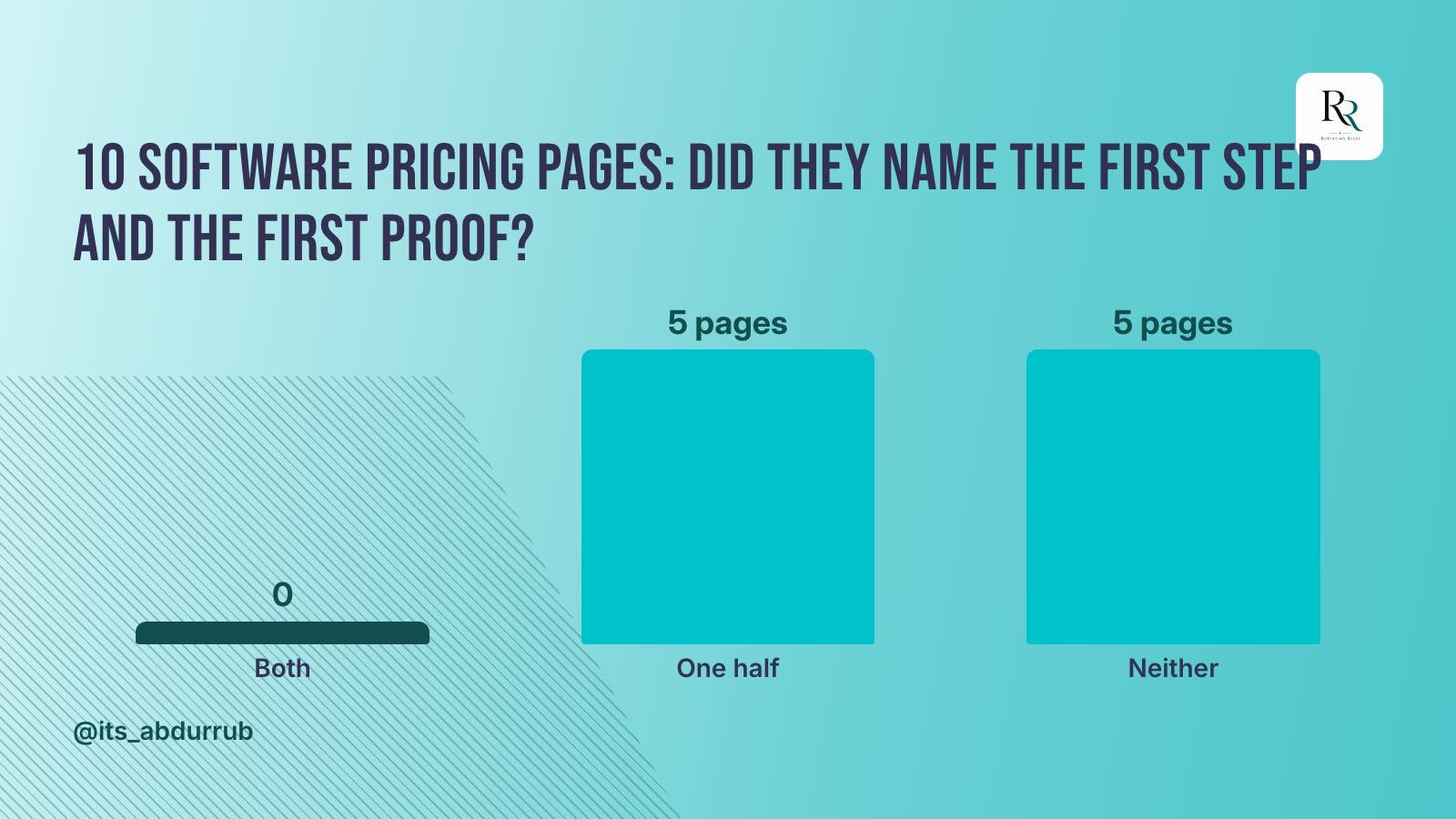
0 of 10 said both.
5 of 10 said one half.
5 of 10 said neither.
The halves were close. One analytics page said you would get “the essential insights on one page in one minute.” That is the result, with no step. Another said to “add” the tool “to your site.” That is the step, with no result. A form builder said you can start “your first form right away.” It never said what you get once the form is live.
Five pages said nothing at all about the first hour. They listed features, plans and a button.
These tools are not bad. Several are loved. That is the point. Even good products leave the first win to chance.
Five things that follow
The first bill is a test of day one. A customer who got a win on day one pays the bill without thinking. A customer who got nothing reads the charge and asks why.
A longer trial does not fix it. Trials on these pages ran 7, 14 or 30 days. More days only give a lost user more time to forget you.
A feature list cannot do the job of a first step. Ten features tell a buyer what is possible. One step tells them what to do now.
The pricing page is part of retention. It is the last page the buyer reads before they pay. What it promises sets what they look for after they sign up.
The churn number arrives late. By the time it moves, the users who left have been gone for weeks. The early sign is quiet: a signup who never did the first useful thing.
The mechanism has a name: the First Win Path
The First Win Path is a short line from “I paid” to “it worked.” It has three parts.
The first step. One action the buyer takes in the first 10 minutes. Paste a line of code. Import a list. Send one form.
The first proof. What they see when it works. A visit on the chart. A reply in the inbox. A booked call on the calendar.
The first promise. Both of those, said on the pricing page, before they pay. The buyer walks in knowing what to do and what to look for.
Here is a made-up line for a booking tool, to show the shape: “Connect your calendar. Share one link. Watch your first booking land today.” Three short sentences. The buyer knows the step, the proof and the time. None of the 10 pages I read had a line like it.
Then your first email has one job. If the step happened, show the proof. If not, send the step again with a short video.
Why it works is plain. People stay where they have already put in effort and seen a result. A small win early is the start of a habit. Leaving after a win feels like losing something. Leaving before a win feels like nothing at all.
What the numbers say about speed
The early drop is not a guess. In 2015, Andrew Chen published data from Quettra, drawn from over 125 million Android phones. His summary: “the average app loses 77% of its DAUs within the first 3 days after the install.” DAUs means daily users. By day 30 it was 90 percent. Those numbers come from phone apps. Paid software moves slower, but the shape still matters. The loss is front-loaded.
A 2025 report from OnRamp asked 161 people who run onboarding at software companies. They said “nearly half of customers will abandon onboarding if they do not see value quickly.” That is a survey of what the teams believe, from a company that sells onboarding software.
You will also see a line on many blogs that 70 percent of churn happens in the first 90 days. I looked for where it came from and could not find a study behind it. So I will not use it. You should not either.
The two sources point the same way. People decide fast. The first days carry the weight.
Where this breaks
This does not help a product nobody wants. If the core job is weak, a faster first win only shows the weak spot sooner.
It also does less for tools where the win takes weeks by nature. A tax tool or a hiring tool cannot show its full result in 10 minutes. Even there, a small proof still counts: a saved draft, a first match, a first number on the screen.
And it will not save a customer who bought by mistake. Some cancels are the right cancels. Let them go cleanly.
What to count on Monday
On Monday, open your own pricing page. Read it like a stranger. Write down the first step and the first proof it promises. If you cannot write both in one line each, a new buyer cannot either.
Then open your signup list from last month. Count how many people did the first useful thing in their first day. That count predicts next month’s churn before the churn number moves.
If this helped, subscribe for the next count.
Ecommerce brands: see the flows at flows.retentionrules.com.
Coaches and software founders: book a call at abdurrub.com.